The creative brief, to me, is a document which maps out the most important parts of the brief going forward in creating a design which reaches the goals of the brief. Including an overview of the brief, target audiences, important information to use and the different parts of the design process, as well as other examples of best practice to take influence from.
Client:
Diane Crone/Paul Sellars
DMCrone@cardiffmet.ac.uk
PSellars@cardiffmet.ac.uk
Brief: SPHERE – Sport healing rehabilitation
Overview: SPHERE is a rehabilitation project aiming to aid people with psychiatric disorders such as depression, anxiety, bipolar disorder etc. using physical exercise. The programme looks to achieve this by improving their quality of life, health and wellbeing. The programme is a collective of 7 partners from around Europe, based in Finland, Croatia, England, Wales, Germany and Belgium, and are a combination of organisations and professionals from academia, psychiatric services, local authority sports development and third sector physical activity providers who all informed the SPHERE project through research and their own examples of best practice within their designated field.
Objective: To provide information about the guidelines to use physical exercise to increase mental health to a range of professionals such as physiotherapists, psychiatrists, mental health nurses etc. in order for them to pass this information on within their own practice.
Target Audience: The primary target audience includes a vast range of professionals within medical services such as mental health nurses, physiotherapists, psychiatrists, occupational therapists etc. It’s also important to consider the secondary audience, the patients receiving the guidelines, as although they aren’t the main focal point for the work, they’re ultimately the people gaining from it.
Useful Information:
The main information which needs to be conveyed to the recipients is the 17 guidelines which aim to aid in mental health rehabilitation, these include things like:
• Attendance to the programme is voluntary
• Where possible, training to take place before mid-day
• Activity in groups to aid social integration and social confidence
Creative Process:
•Further research into the brief and surrounding topics
•Design solutions ideation
•Visual identity ideation
•3 design solutions
•Development of direction
•Refinement
•Design proposal presentation
•Final design delivery
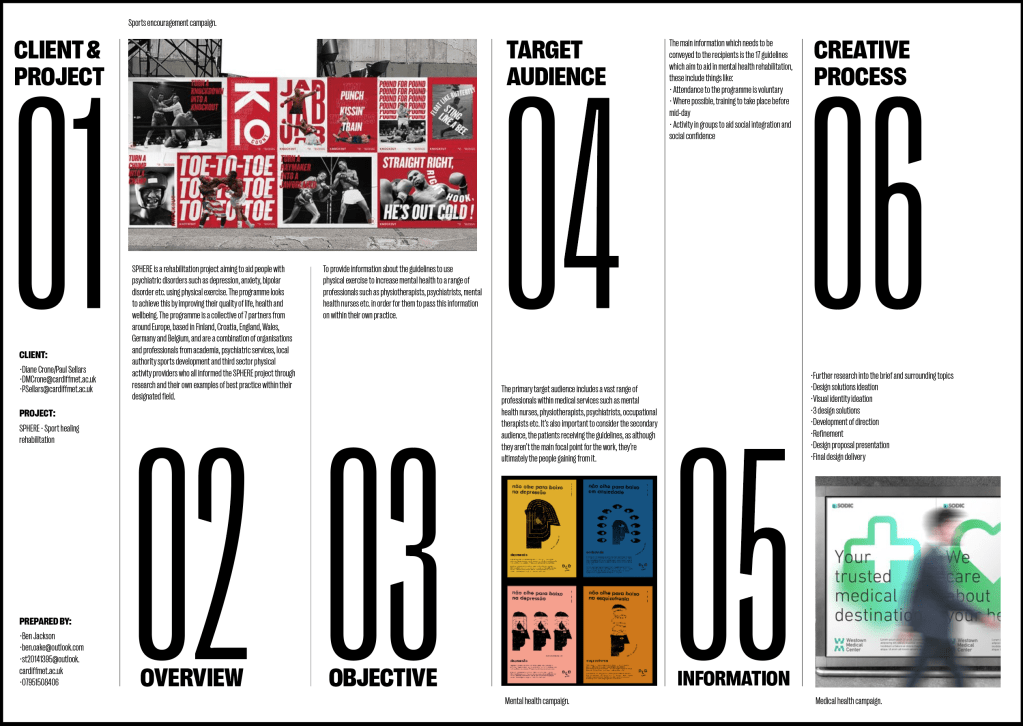
Helpful Visuals: Before carrying out too much research into the topic and surrounding research I thought it was important to look into visuals which allude to a variety of different topics which the brief looks into, such as sports, mental health and medicine in order to document some early research into the type of design which will be of interest.
 Ben Jackson