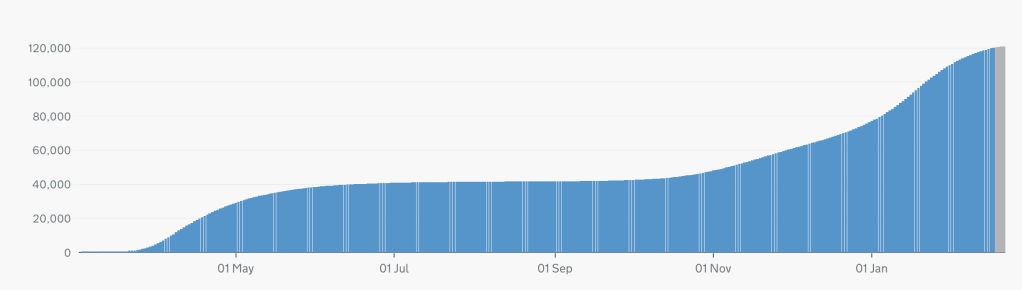
Before starting to unpick the governments response to the pandemic, I first wanted to get a feel for how bad the pandemic really was, from deaths to hospitalisations. While deaths have been spoken about every day on the news and all over TV, I still don’t think many people have gotten a feel for just how bad it has been, which could be down to the way it was downplayed, especially in the initial stages.
In the Uk since the virus first reached us, there have been over 120,000 deaths related to Covid and over 4,000,000 confirmed cases, the most in Europe and double the likes of Spain and Germany, as well as being over 30,000 above Italy who sit with the second most. In terms of the world as a whole, Uk are in the top 5 for death toll only beaten by the likes of America, Brazil, India and Mexico, all of which have double the population of the uk. Whilst there are other factors to death rate tallies, it is clear to see that with the size of the Uk compared to other countries around the world, sitting at 26th in terms of population size, we should be no where near the top 5 in terms of deaths.
Whilst other factors come into play, the death toll is one of the main reasons for 51% of British people stating that they think the governments handling of the pandemic to be a humiliation, stating that they are angry with the way the government have made decisions, in many cases purely because many safety measures have been implemented too late, or taken away too quickly.
“Some of the reasons for this shift are clear – around two-thirds think the Government failed to prepare properly for a second wave of coronavirus infections and the same proportion think its approach has been confused and inconsistent.“
“These perceived failings have provoked strong feelings in many people, with half of the public saying they think the handling of the pandemic has been a national humiliation, and the same proportion saying they’re angry with the Government because of its response.“
https://www.dailyrecord.co.uk/news/scottish-news/most-people-think-uk-governments-23123448
The Guardian released the article ‘Covid chaos: how the UK handled the coronavirus crisis’ which is a step by step run through of the Governments decisions throughout the pandemic snd the way they handled the virus, pointing out good and bad points along the way, however unfortunately the majority are bad. The first few months are noticeably bad in some of the announcements, these being the most important for me when looking at initial responses to the pandemic.
The year since the pandemic began is one that nobody is likely to forget. In the UK, more than 100,000 people have died of Covid and the effects of the pandemic – both societal and economic – have been seismic.
While progress has been made, most notably with the UK’s rapid vaccine rollout, it comes as deaths continue to rise, leaving countless people bereaved. Multiple government missteps, miscalculations and delayed responses have contributed to the death toll.
The government’s early success with vaccinations (10 million first-dose vaccines and counting) is positive, but will this change how history judges its response to the emergency?
11th March – Tests to be expanded …
1,215 people have been tested for coronavirus. The health secretary, Matt Hancock, insists the government is “rolling out a big expansion of testing” but declines to give a specific timetable.
12th March – … but first, tests to be restricted
The UK moves from the “contain” to the “delay” phase of its plan to tackle coronavirus. Boris Johnson announces that health workers will no longer test people for the virus in their homes, but will continue to test people already in hospitals.
The first of many decisions which the public questioned, testing in hospitals with the threat of already having the virus but not at home before leaving to go anywhere?
13th March – Vallance defends ‘herd immunity’…
Sir Patrick Vallance, England’s chief scientific adviser, defends the government’s approach to tackling the coronavirus, saying it could have the benefit of creating “herd immunity” across the population.
The first point of complete confusion among the general public, herd immunity was spoken about excessively at the start and many were outraged by this response. Although the government decided not to venture down this path, it was still considered by the government as a liable way to defend against the pandemic even though people would lose their lives in the process. Something which could definitely be used within the project.
13th March – Government eventually bans mass gatherings … after pressure mounts
The government announces a forthcoming ban on mass gatherings after increasing pressure on its approach to the virus, which is considered markedly different to other countries.
Social distancing and mass gatherings being banned came into place far later the other countries. Did we know something no one else did or was this incompetence?
17th March – Vallance says 20,000 Covid deaths a “good outcome”
Sir Patrick Vallance tells MPs that keeping the total number of Covid-19 deaths under 20,000 would be “a good outcome”. Two days later Johnson says the UK can “turn the tide” before the summer, citing potential antibody tests. He says the UK can “send coronavirus packing but only if … we all take the steps that we have outlined”
One of the most memorable times in the initial stages of covid for me, seeing outrage all over social media and the news where Vallance says that 20,000 deaths is a ‘good outcome’? It’s almost as if the death rates didn’t;t matter to the government as long as we had less than other countries. Whilst the quote itself is taken out of context, the words ‘good outcome’ could allow the quote to be used in my project to illustrate the way in which the pandemic maybe wasn’t taken seriously enough from the start.
25th March – Johnson says the UK is aiming for 250,000 tests a day
“We are going up from 5,000 to 10,000 tests per day, to 25,000, hopefully very soon up to 250,000 per day.” Number of tests performed: 6,583.
250,000 tests a day to 6,583 per day? Again did the government know something no one else did or was this incompetence on their part?
13th April – Raab says ‘plan is working’ as the UK hits 20,000 deaths
The foreign secretary, Dominic Raab, says the country is starting to “win this struggle” but that it is not yet past the peak. Amid concerns over a shortage of PPE supplies in parts of the UK, he says “we understand the importance of getting PPE to the frontline”, and that over the bank holiday weekend “over 16m items were delivered”
Stating that we’re winning the struggle after 20,000 deaths is just crazy, shows a lack of respect for the job at hand and a lack of remorse for the people who have died – again is this just Raab talking slightly out of line or is it that the virus still isn’t being taken seriously enough?
22nd May – Dominic Cummings revealed to have breached lockdown
In a joint exclusive, the Guardian and the Mirror reveal that Dominic Cummings breached the government’s lockdown rules. The prime minister’s key adviser had been seen in Durham at the end of March, 264 miles from his London home, while he had symptoms of coronavirus. Despite the weeks of national uproar that followed, Johnson refuses to sack Cummings.
When the PM’s key adviser isn’t following his own rules it shows that there is complete disrespect for the people who are dying, losing their jobs, houses etc and again shows that the virus and the scientists advice isn’t being taken seriously.
Whilst not all of the points outlined are points which i’m looking to use in the project, they do all outline this idea that the handling of the initial covid response wasn’t up to scratch, and it could be argued that this allowed for thousands of unnecessary deaths along the way.
Many of the quotes or responses make the pandemic seem like nothing to worry about, saying that herd immunity is a liable approach, taking longer than advised to move into lockdown, stating that 20,000 deaths is a good outcome, all lead to the point that there were many aspects of the government response which just outline the fact that the virus in many cases wasn’t taken seriously and was never treated as well as it should have been.
 Ben Jackson